You went to work. You answered the messages. You made it to dinner. If someone asks how the day went, you might say it was fine. After all, you did the things you were supposed to do.
But what happened around them? The rest before leaving home. The shorter journey. The shopping you moved to another day because dinner had already used the energy you had left.
I keep returning to this question when I think about women's health: what do we fail to notice when we only ask whether someone managed?
In my reflection on 250 conversations, I wrote about the work that gathers around a chronic condition. Here, I want to stay with something small and practical: finding words for the adjustments that can disappear inside an ordinary answer.
What did “I managed” require?
A pain score gives you a shorthand. It leaves much of the day unexplained. Consider these fictional examples:
- You attended a meeting, but lay down before it and postponed your errands afterwards.
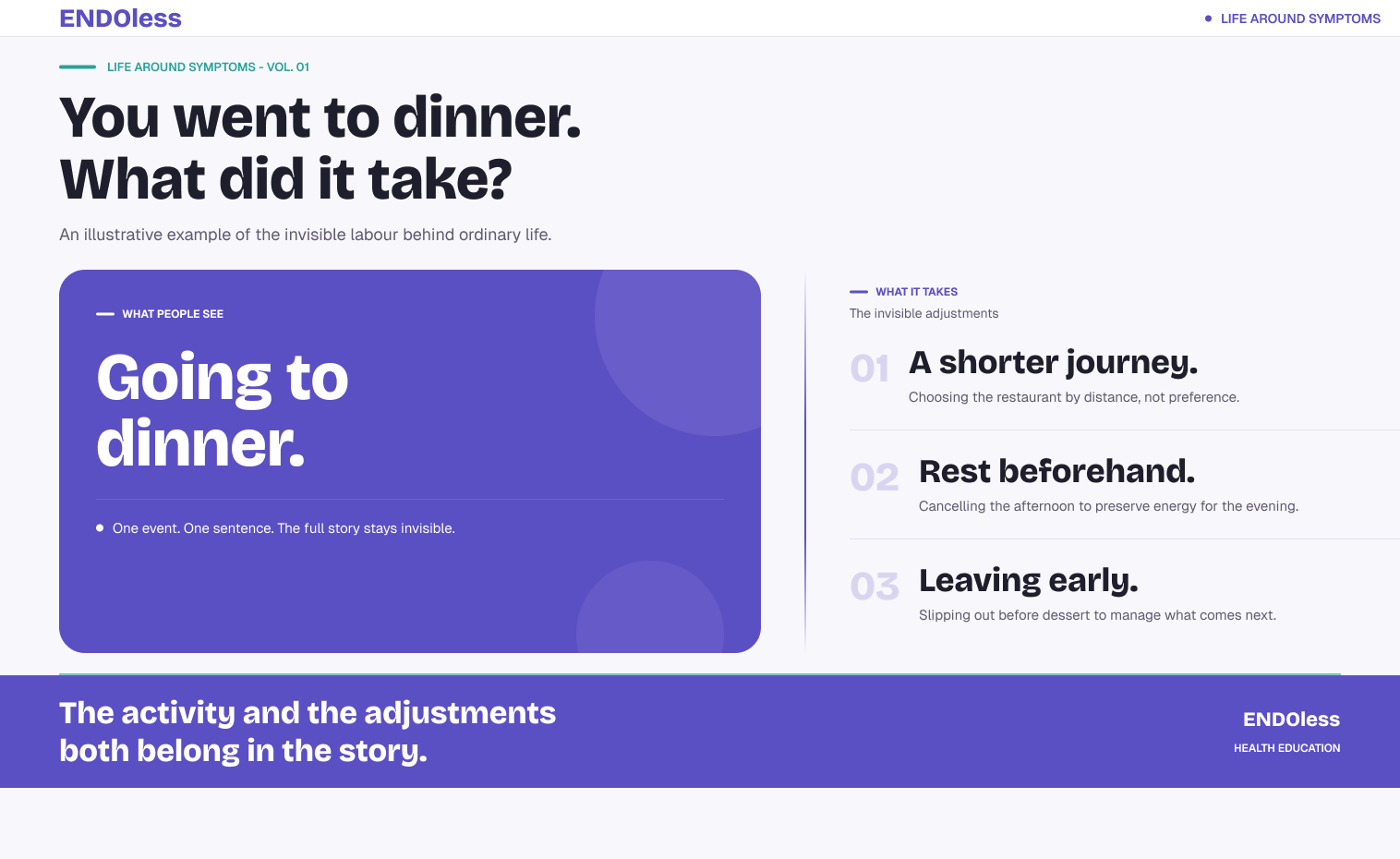
- You joined friends for dinner, but chose the venue around the journey and left early.
- You completed your usual work, but took additional breaks and had no energy for your evening plans.
The meeting still happened. So did the dinner. Those visible outcomes tell us very little about what each person had to rearrange.
The activity happened. So did the adjustment. Both belong in the account of that day.
I find that important because “I was able to” can close a conversation just when there is something worth understanding. Being able to do something does not tell us how much it asked of you.
A sentence with room for the rest
When you want to explain that effort, try this:
I was able to ___, but I needed to ___, and afterwards ___.
For example: “I was able to do the shopping, but I needed to shorten the trip, and afterwards I rested instead of cooking.”
You could say it aloud, put it in a message or keep it in a private note. Something you chose not to do can belong there too. There is no need to keep an inventory of every compromise; choose the detail that helps you say what you mean.
And you do not have to turn this into evidence that you deserve support. I would hate for a useful prompt to become another demand to justify yourself.
What would actually help?
At an appointment, an example might open a more specific conversation: “I am still attending work, but I am changing the rest of my day around symptoms. I want to discuss that impact.”
France's Assurance Maladie describes how endometriosis pain can interfere with daily activities and attendance at work or school. The changes you make around those activities are worth describing to the healthcare professional who follows you.
With someone close to you, a useful next sentence might be much shorter:
- With a friend: “Could we choose somewhere closer to home?”
- With someone you live with: “Could you take care of dinner tonight?”
- When making a plan: “Can we leave the end time flexible?”
Or simply: “I would like to come, but I need the option to leave early without explaining again.”
You decide how much of your health story to share. A specific request can be enough. The point is to give someone a way to help without making you explain everything first.
Leave room for the day to be different
Some days may need fewer adjustments. Others may ask for more. An easier day does not erase a difficult one, and one difficult day does not have to describe your whole life.
I want that room for variation in the way we build ENDOless, too. If we ask someone for a number, have we left space for them to explain what the number cannot carry? Can they describe the effort around an activity, including the things they gave up to make it possible?
These are questions about what we choose to notice. They matter before we decide what to measure.
A prompt to keep: What did I change today to make the day possible? Write down one answer if it feels useful. It can stay private.