Endometriosis is not a trend.
It is not a lifestyle condition.
And it is not a niche women’s issue.
It is one of the most prevalent chronic diseases affecting women worldwide - and one of the least measured.
Endometriosis is a chronic, systemic inflammatory disease that affects an estimated 1 in 10 women worldwide — nearly 190 million people (World Health Organization).
Yet despite its prevalence, endometriosis remains one of the most delayed, misunderstood, and under-measured conditions in modern medicine.
I didn’t start working on endometriosis because it was a good market opportunity.
I did it because living with it – and listening to thousands of women – makes one thing painfully clear:
The problem isn’t awareness.
The problem is how poorly women’s pain is structured, measured, and trusted - in clinics, in data, and in society.
This article explains the medical basics of endometriosis and the systemic failures around it – and also why better tools and data are no longer optional.
What is endometriosis – and why I care so deeply about explaining it well
Endometriosis – often called "endo" – is not “just bad periods”. It is a chronic condition that quietly rearranges your life around pain, fatigue, and uncertainty.
In simple terms, it happens when tissue similar to the uterine lining (endometrium) grows outside the uterus, in places where it doesn’t belong. Each month, this tissue reacts to hormones like a period would – but unlike a period, it has nowhere to go.
So it stays.
It inflames.
It scars.
It hurts.
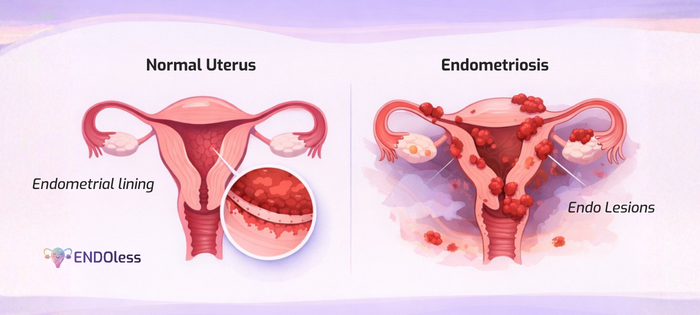
Over time, that hurt can become many things at once: pain that comes and goes, pain that settles in and refuses to leave, and a level of exhaustion that no amount of sleep can touch. You wake up tired. You go to bed tired. In between, you’re trying to be “fine” for everyone else.
I care about explaining this clearly because I know how disorienting endometriosis can be – not only in the body, but in the mind.
When your pain is irregular, invisible, and hard to describe, you start turning the doubt inward
Maybe I’m exaggerating.
Maybe everyone feels this and just copes better.
Maybe it’s in my head.
I did that. For a long time.
And I’ve met countless women who did the same – ambitious, capable, responsible women silently reorganising their entire lives around pain while still performing, still smiling, still showing up.
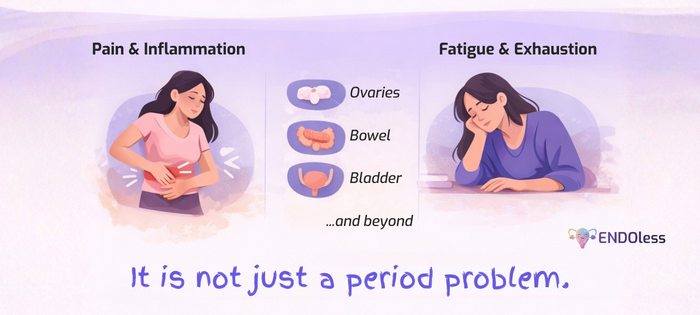
Endometriosis is not just about periods. It can show up:
- outside the menstrual cycle
- during ovulation
- during or after sex
- when eating or digesting
- when sitting, standing, walking – or simply existing in your body
Some days are “manageable”: you negotiate with your pain, you plan your day around it, you adapt.
Other days, it quietly takes everything out of you – your concentration, your patience, your joy – and from the outside, nothing looks “serious” enough to justify how bad you feel.
There is no cast, no visible wound, no dramatic moment. Instead, there are cancelled plans, rearranged careers, postponed dreams, and a constant mental calculation:
If I say yes to this, what will it cost my body later?
This is why I am so demanding about the way we talk about endometriosis.
Words shape reality.
They influence how doctors listen, how workplaces respond, how families support, and how policymakers prioritise.
When we reduce endo to “painful periods”, we erase the people who can’t sit through a meeting, can’t stand upright in the shower, can’t enjoy sex without pain, or whose fertility, work, and relationships are deeply affected.
For me, explaining endometriosis well is not a branding exercise or an awareness slogan. It is a responsibility.
Because understanding what endometriosis really is – in simple, honest, non-dramatic terms – is the first step toward being believed.
And being heard changes everything: it shapes how quickly you are diagnosed, what treatment pathways are open to you, what accommodations you feel legitimate asking for, and how you speak to yourself when your body sets limits you never chose.
Why diagnosis is still so difficult
Endometriosis is notoriously hard to diagnose.
- Blood tests are unreliable
- Ultrasounds often miss lesions
- MRI can help, but is not definitive
- Surgery remains the gold standard – and is invasive
Most medical appointments capture snapshots, not patterns.
Pain that comes and goes is easy to minimise.
Data that doesn’t exist can’t be used.
Up to 50% of women with chronic pelvic pain have endometriosis
– The Lancet
This is not a failure of individual doctors.
It is a systemic failure of continuity, data, and context.
Endometriosis doesn’t only affect health.
It affects lives.
Women with endometriosis are 50% more likely to reduce or leave work
– Harvard T.H. Chan School of Public Health
On average, women lose 10+ workdays per year
– World Economic Forum / McKinsey Health Institute
Globally, endometriosis costs the economy ≈ $280 billion per year
in healthcare expenses and lost productivity
– The Lancet Global Health
Behind those numbers are quiet stories:
careers slowed, ambitions postponed, confidence eroded.
Many women are forced – implicitly or explicitly – to choose between their health and their lives.
We should never have to make that choice.
There is no simple solution – and that’s the hardest truth
Some people are given pills.
Some are advised to have surgery.
Sometimes it helps.
Sometimes it doesn’t.
And often, it helps for a while – then stops.
What I've learnt the hard way is this:
Endometriosis is not something you “fix” once and move on from.
Two women with the same diagnosis can live completely different realities.
What eases pain for one can make things worse for another.
What works this year may not work next year.
Care often feels like trial and error – and that uncertainty is exhausting.
Not because women aren’t trying hard enough.
But because the condition itself is complex.
Why I built ENDOless
I built ENDOless because I got tired of feeling like I had to prove my pain.
Not to replace care.
Not to promise miracles.
But to help women make their experience visible – over time, in their own words, at their own pace.
Because being believed should not depend on how well you summarise your life in 15 minutes.
One last thing
If you’re reading this and recognising yourself:
you’re not exaggerating.
you’re not weak.
and you’re not alone.
Endometriosis is real.
Women’s pain is real.
And we deserve systems that actually listen.
That’s why ENDOless exists.
If you want to help us accelerate this mission, you can leave a tip and directly support the work behind it.